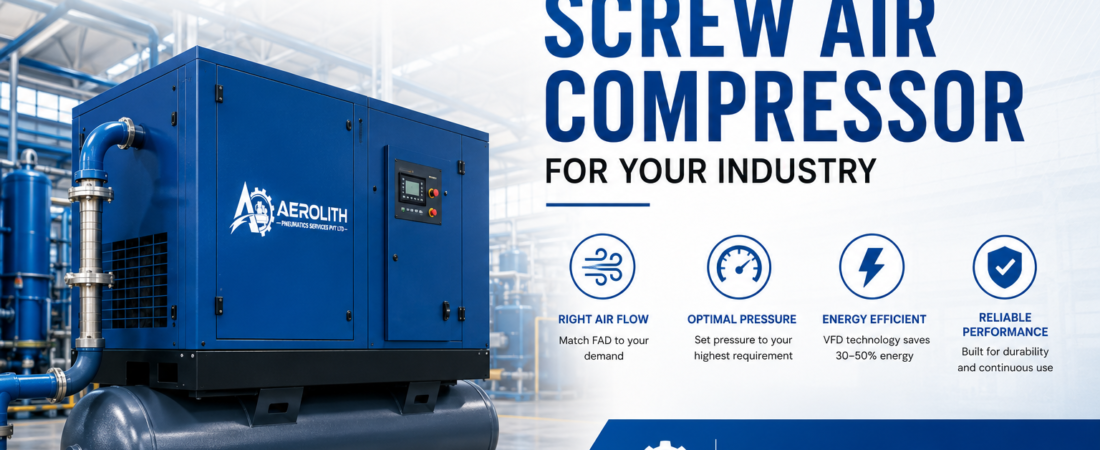
Selecting the right screw air compressor starts with a clear understanding of your facility’s air demand. Two critical parameters drive every compressor selection: Free Air Delivery (FAD) and working pressure. Getting the specification right from the start avoids costly under- or over-sizing.
Key Highlights
- Match FAD (CFM/LPM) to combined tool demand plus 25% margin
- Set pressure to your highest-demand equipment requirement
- VFD models save 30–50% energy for variable demand profiles
- Expert site assessment available at no obligation
Understanding Your Compressed Air Requirements
Undersizing your compressor leads to pressure drops and production interruptions. Oversizing wastes capital and energy. The two key numbers to establish are Free Air Delivery (FAD) — measured in CFM or LPM — and working pressure in bar or PSI.
Key Factors to Consider
Evaluate each of the following before making a purchase:
- Air Flow (FAD): Add up the air consumption of all tools and equipment that may run simultaneously, then apply a 25% safety margin.
- Working Pressure: Match the compressor’s rated pressure to your highest-demand equipment. Most industrial applications operate at 7–10 bar.
- Duty Cycle: For continuous operations, rotary screw compressors are ideal. For intermittent use, a piston compressor may suffice.
- Power Supply: Confirm available voltage and phase (single-phase vs three-phase) before ordering.
- Environment: Hot, dusty, or humid conditions require additional filtration and cooling provisions.
Fixed Speed vs VFD Screw Compressors
Fixed-speed screw compressors run at constant RPM regardless of demand, making them best suited to applications where air usage is consistent throughout the day.
VFD compressors adjust motor speed in real time to match actual demand. If your air usage fluctuates — common in most factories — a VFD model will deliver 30–50% energy savings over a fixed-speed unit.
Industry-Specific Recommendations
Different industries have different compressed air profiles:
- Textile & Garment: High continuous flow at moderate pressure — ideal for PM VFD screw compressors with integrated dryers.
- Food & Beverage: Oil-free or ultra-low-oil compressors are recommended to prevent contamination.
- Automotive & Metal Fabrication: High-pressure, high-flow systems with large air receivers for surge demand.
- Healthcare & Pharmaceuticals: Medical-grade oil-free compressors with sterile filtration.
- Construction & Mining: Portable diesel-driven compressors for remote or off-grid sites.
Frequently Asked Questions
What size air compressor do I need for my factory?
The right size depends on the total Free Air Delivery (FAD) required by all your pneumatic tools and equipment running simultaneously, plus a 25% safety margin. Our engineers can visit your site and calculate the exact requirement free of charge.
What is the difference between a screw and piston compressor?
Rotary screw compressors are designed for continuous duty — they run smoothly, quietly, and efficiently for extended periods. Piston (reciprocating) compressors are better suited to intermittent use and lower air volumes. For most industrial applications, a screw compressor is the preferred choice.
Should I buy a fixed-speed or VFD compressor?
If your air demand is relatively constant throughout the shift, a fixed-speed model is cost-effective. If demand fluctuates significantly — as it does in most factories — a VFD model will save 30–50% on electricity and typically pays back the price premium within 2–3 years.
Do you provide installation after purchase?
Yes, AP Compressors handles full installation and commissioning for all compressors we supply. Our engineers ensure the system is correctly integrated with your existing pipework, electrical supply, and any downstream air treatment equipment.